1 April 2026
Missile targeting, radio encryption, GPS and even basic map‑and‑compass navigation all rely on mathematics – the fundamental language and invisible framework behind much of Defence’s technology.
Another field where maths reigns supreme is computer modelling, an area that Tamara Tambyah, a mathematician with Defence Science and Technology Group, has been advancing.
While completing a PhD on numerical weather prediction – the mathematics behind the next generation of weather models Australia will adopt in the coming years – she is applying her skills in Defence.
Her work focuses on modelling the effects of chemical, biological, radiological and nuclear threats (CBRN).
She said there are two sides to mathematics: pure mathematics, and applied and computational mathematics.
The latter uses advanced mathematical methods, algorithms and computer science to solve complex, real‑world problems through simulation and modelling, which isn’t always about the numbers.
“In my area of maths, I rarely look at the numbers,” Miss Tambyah said.
“I look at the relationship between variables, like how force is proportional to mass, and represent quantities symbolically in equations. The numerical value of variables only matters at the very end.”
As CBRN scenarios are difficult and expensive to re-create in real life, computer simulation helps assess the effectiveness of contingency plans and identify areas for improvement.
These equations are dominated by symbolic representation, using letters and specialised symbols to describe relationships rather than fixed numerical values.
When modelling CBRN threats in the physical environment, variables are myriad and the relationships between them complex.
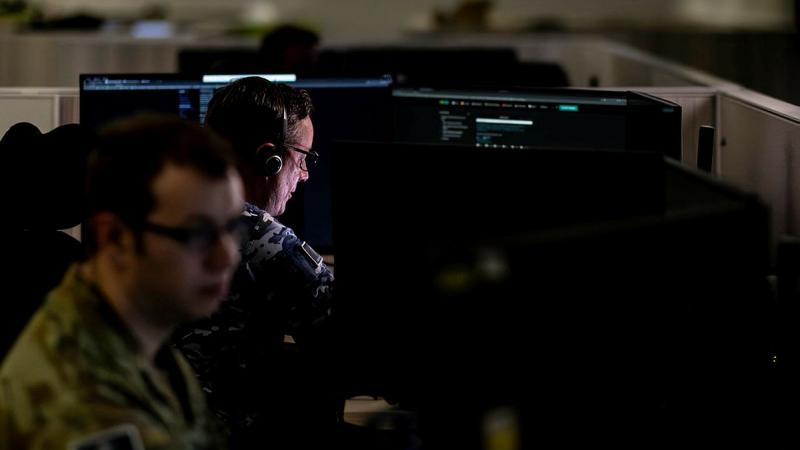
Miss Tambyah said computer programming is a way of doing maths at scale, which is useful when modelling CBRN threats with numerous interacting variables.
“We can predict the effect of CBRN hazards under different weather conditions,” she said.
These include atmospheric dispersion, how it deposits to the ground, how it impacts health and how people respond in emergency situations.
“If they see a big plume, how will they react?” she said.
As CBRN scenarios are difficult and expensive to re-create in real life, computer simulation helps assess the effectiveness of contingency plans and identify areas for improvement.
This allows questions to be answered about deadly scenarios that would be unethical or impractical to recreate in real life.
The work is part of Defence Science and Technology Group’s research into preventing, responding to and defending against CBRN attacks.