19 June 2026
With a population of under 10,000 people, no military and only 134 police, the small Pacific nation of Tuvalu values the support of its neighbours.
Particularly when disaster hits, such as tropical cyclones or flooding.
That is where the Pacific Response Group (PRG) comes in, because the multinational military unit provides humanitarian assistance and disaster relief to Pacific nations when they need it.
Tuvalu Police Inspector Tualua Tepoga said, as a small police service, they valued the PRG as an important regional capability that strengthened disaster preparedness, response and resilience across the Pacific.
“The PRG can provide additional personnel, expertise and resources to support disaster responses when Tuvalu capacity is stretched,” he said.
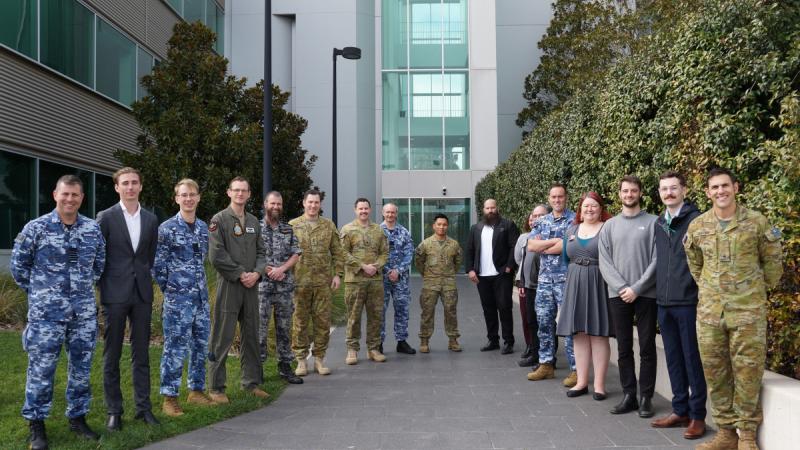
Mr Tepoga and colleague Tepaula Emau, along with Samoan Police Inspector Sione Menefata, recently joined the PRG and almost 1000 military personnel at the French-led Exercise Marara in French Polynesia to train in disaster relief operations.
The police inspectors sat down with Commander PRG Lieutenant Colonel Scott Hill and PRG members to discuss the group’s role in conducting damage assessments.
The unit’s six-member forward planning team also assesses what military assistance is required, including health, military engineering and logistics.
'The PRG can provide additional personnel, expertise and resources to support disaster responses when Tuvalu capacity is stretched.'
With fewer than 1000 police officers for Samoa’s population of more than 200,000 people, Mr Menefata said the PRG could support his country’s National Emergency Operations Centre in a disaster event.
“The PRG could rapidly deploy a team to work alongside Samoa authorities with coordinating, assessing and advising,” Mr Menefata said.
Lieutenant Colonel Hill explained to the police inspectors the PRG’s three tenets for disaster support.
“Firstly, the host nation has to ask for assistance, it’s only ever on request,” he said.
“Secondly, it should be civilian-led. And finally, it must be as civilian as possible, and as military as necessary.”
The simplest way of operating, Lieutenant Colonel Hill added, was when the host nation clearly stated what it needed to achieve.
“You can tell the PRG you need fresh water, and it’s up to our planners to work out the best way to get that to you,” he said.
“We can organise a team of military engineers to provide water desalination plants supplying fresh water.
“You might tell us you need to get to 100 people on an island you cannot reach.
“The options could be a French helicopter, an Australian small landing ship or an airdrop from a New Zealand C-130 Hercules aircraft.”
'Our aim is to make life easier, not harder, and that’s a real privilege for us.'
The PRG was established in October 2024 following a decision of the South Pacific Defence Ministers’ Meeting.
Just 11 weeks later, the group was on the ground in Vanuatu following a 7.3-magnitude earthquake.
The PRG members – Australia, Fiji, France, New Zealand, Papua New Guinea and Tonga – support the 18 Pacific Island Forum nations, including Tuvalu and Samoa.
“Even before the PRG, we always looked after each other,” Lieutenant Colonel Hill said.
“It’s about being good neighbours. But what the PRG also provides is that cultural familiarity. We are a Pacific unit and a regional asset.
“Our aim is to make life easier, not harder, and that’s a real privilege for us.”