28 April 2026
Army signals personnel deployed across the country for Exercise Mercury Run to prepare 1st (Australian) Division for the year’s major warfighting exercises.
About 130 personnel from 1st Signal Regiment, including elements from multiple squadrons responsible for command nodes, planning support and network operations, participated in the March exercise.
Signal units from across the division tested and validated the networks that underpin command and control.
Lieutenant Jarrod Johnson, a communications officer with 1st Signal Regiment, said the exercise ensured commanders could communicate seamlessly across a complex and geographically dispersed battlespace.
“Exercise Mercury Run is essentially the division’s first opportunity to bring all of our signal units together and test our systems in a realistic environment,” Lieutenant Johnson said.
“It’s about making sure the networks that support commanders and planners are established, secure and reliable before the broader warfighting activities begin.”
Deployable communications nodes were established, capable of supporting a range of command elements, from small executive teams through to large planning staffs.
Depending on where a node sits in the battlespace, its footprint can vary significantly.
“At one end of the spectrum you might have a very small set-up supporting the divisional commander and their executive team,” Lieutenant Johnson said.
“At the other end, there are nodes supporting hundreds of users, requiring multiple servers, large numbers of laptops and supporting infrastructure like power and lighting.”
'Our role is to give commanders and soldiers the ability to communicate with anyone in the battlespace, at any time, across any service.'
Modern military communications resemble digital office environments, transforming how commanders plan and direct operations.
“Gone are the days where information only moves down the chain verbally over radios,” Lieutenant Johnson said.
“Commanders and soldiers now access written plans, orders and updates through secure deployable networks, often in near real time.”
These capabilities enable commanders to make informed decisions and coordinate forces more effectively.
Mercury Run was a precursor to Exercise Polygon Wood, the division’s major planning exercise.
Over two weeks, signals personnel deployed early to establish the communications backbone that would later support divisional and brigade headquarters during their planning activities.
“There would be minimal changes to our planning processes, equipment or systems if this were a real-world operation,” Lieutenant Johnson said.
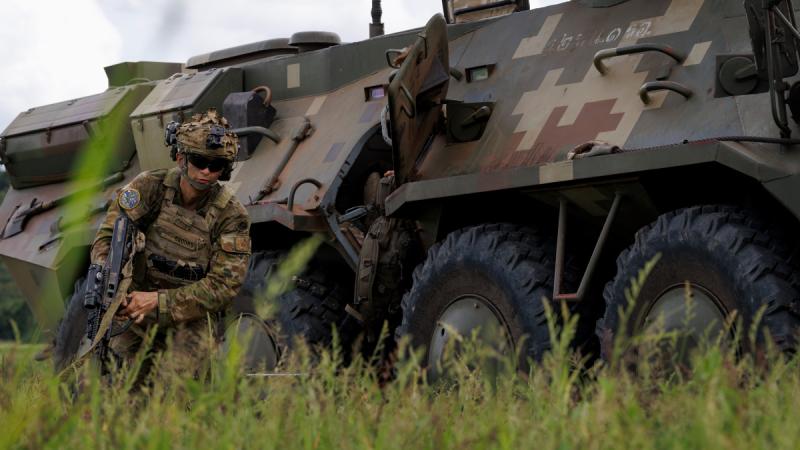
For soldiers on the ground, Mercury Run provided an opportunity to put months of preparation into practice.
'Commanders and soldiers now access written plans, orders and updates through secure deployable networks, often in near real time.'
Signaller Shannon Weerakkody, of 102 Squadron, said the realism was valuable.
“The exercise was about network baselining across the regiment – making sure everyone is up to spec, understands the required standards, and has their systems configured properly,” Signaller Weerakkody said.
“It’s mostly signals-focused, particularly communications, so that everything is ready for future exercises or operations.
“We were training how we fight – using field bearers [satellite connections] instead of barracks connections. You learn what the equipment is actually capable of under operational conditions.”
Not everything went smoothly, but that is where the training became valuable.
“You have to troubleshoot in-house and work with smart people across the brigades to solve problems quickly,” Signaller Weerakkody said.
“There will always be issues, so keeping your troubleshooting and problem-solving skills sharp is essential.”
Lieutenant Johnson said the exercise reinforced the pride signals soldiers took in enabling the force.
“Our role is to give commanders and soldiers the ability to communicate with anyone in the battlespace, at any time, across any service,” Lieutenant Johnson said.
“That’s something we take a lot of pride in.”