9 April 2026
For HMAS Stuart, leading the final division of ships into Sydney Harbour for the Exercise Kakadu Fleet Review was just the start of the ship’s Kakadu contribution.
The west-based ship known as the ‘Tartan Terror’, was critically involved in working with participating international partners alongside in Sydney and when she returned to sea to engage in naval warfighting exercises.
Commanding Officer Stuart Commander Aaron Scott spoke about the ship’s involvement with Exercise Kakadu.
“It was an incredible privilege for Stuart to lead the final column of ships during the Kakadu Fleet Review, celebrating 125 years of Navy,” Commander Scott said.
“We’ve also exercised our mariner and warfighting skills with our partner nations from all around the world, which has been fantastic.”
After the pageantry of the Fleet Review, participating ships spent time alongside Fleet Base East, Sydney, for the Kakadu shore phase. A multitude of events and activities took place during this time, involving crews from more than 18 partner nations.
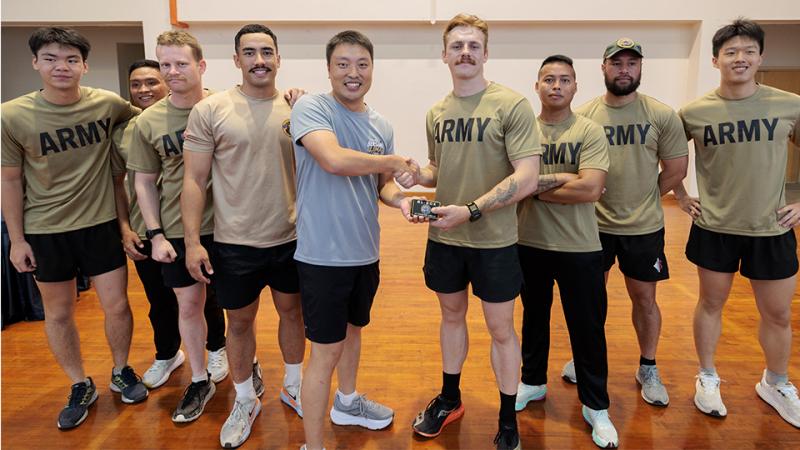
Members of Stuart’s crew engaged with international crews, participating in ship tours, cultural events, sporting challenges and even reciprocal training.
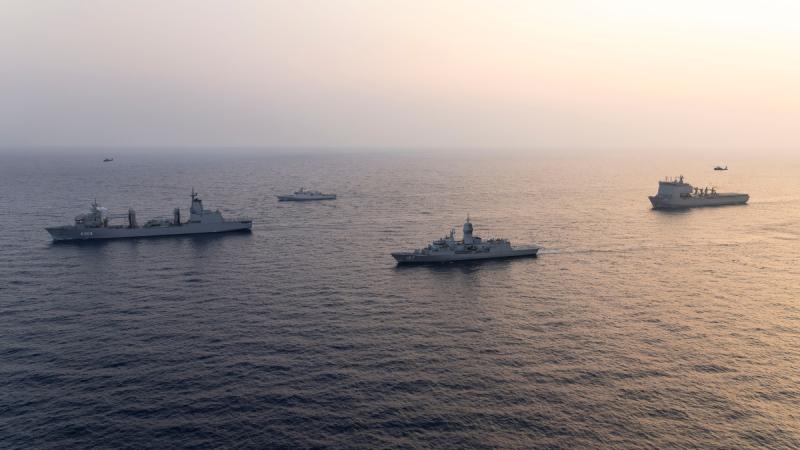
After the shore phase, Stuart proceeded to sea, her bagpiper playing on the forecastle. HMAS Ballarat, Japanese Ship Kumano and a separate task force led by HMAS Choules joined her at sea.
“During the Kakadu sea phase, we have exercised our anti-submarine and surface engagement warfare, as well as our naval gunnery skills,” Commander Scott said.
“This tests our integration with partners and ensures we can fight and win at sea, shoulder to shoulder, should the need arise.”
'It was an incredible privilege for Stuart to lead the final column of ships during the Kakadu Fleet Review, celebrating 125 years of Navy.'
A key element of the sea phase was the naval gunfire support exercise that took place off Beecroft weapons range north of Jervis Bay, NSW. Directed by Army soldiers, the ship fired live 5-inch rounds from its Mark 45 gun at targets on the range.
Naval gunfire supports troops ashore or the ships themselves in destroying enemy targets that pose a threat to friendly forces.
“The ADF fights as an integrated force,” Commander Scott said.
“It’s important that Navy be able to work with Army and the Air Force to deliver a variety of effects.
“In this particular instance, we were able to exercise as close to real life as it gets, providing gunnery support to soldiers from 2RAR [2nd Battalion, Royal Australian Regiment] ashore.”
Stuart worked closely with Kumano, a Japanese Mogami-class frigate, which the Australian Government has purchased to replace as Australia’s future frigate.
“It’s been really exciting to work with Kumano,” Commander Scott said.
“Our team were lucky enough to engage in reciprocal ship visits with Kumano, during which we rehearsed and familiarised ourselves with each other’s naval gunfire support drills.
“Not only has this been an absolute pleasure, but it has given us the confidence that we can work together with the Japan Maritime Self-Defense Force and the Mogami-class to deliver these effects for the region.”
At its peak, Kakadu involved more than 6000 personnel and 30 naval ships, with activities conducted across northern and eastern Australia, and partner nations attending from Sri Lanka, across the South West Pacific to Canada.
“As the ship’s commanding officer, my focus is on my people and making sure they are comfortable working with our global partners,” Commander Scott said.
“A big part of that has been conducting our cross-decks and interactions with our fellow Kakadu participants.
“Kakadu, and exercises like it, are extremely important for the ADF and for Australia in assuring we can operate effectively with our global partners if and when it is needed.”